Help with Harvard Referencing for University Students

This guide is for those who have no idea how to reference. However, I have no doubt there will be third and fourth year students refreshing their memories on the ins and outs of when and how to cite and reference. This blog entry is intended as a first draft of an instructional video appearing on the Thinking Aloud Youtube channel.

The best thing you can do for if you’re here a refresher is to head over to Anglia Ruskin University’s library web page on the Harvard system. It’s excellent and has been an essential tool for undergraduates and postgraduates since, at least, 2008 (When I remember first using it as an undergrad at Strathclyde). The best thing about it is when you need to know how to cite a more irregular source it tells you what the citation and reference should look like. Load up the page, link is below, and bookmark it. You won’t regret it. Frankly, now I’ve given you this advice and I will repeat it in class too, I expect your referencing to be on point or damn close to it.

This blog covers:

  • Why you need to cite and reference
  • The difference between citations and references
  • When to cite
  • How to cite
  • How to reference

Why you need to cite and reference

  • Displays where your ideas came from
  • Demonstrates the quality of your reading
  • Demonstrates the amount of research conducted
  • Protects against plagiarism

Every marker wants to know where your ideas came from. The first thing a marker does is scrutinize the reference list. We want to know what reading you’ve elected to use for your argument. The best thing a marker hopes for is to find a reference list full of academic journal articles capable of teasing apart the intricacies of the assignment. Academic references are king, that means journal articles, books and textbooks, not websites and blogs. If your marker checks your reference list and is confronted by, to be polite, subpar references, you’ve already limited how good the mark can be. The volume and variety of research is very important. Students often ask what the magic number of academic references is… there isn’t one. You could have 30 references providing shallow opinions or 10 references conducting deep analysis. The word limit should help guide the trade-off between quality and quantity. Protection from plagiarism. You are acknowledging other’s work and please, burn this into your brain: Every source you use incorporating others’ work requires citation. No citation declares your writing as original. Therefore, if something goes uncited and it’s not original then you’ve plagiarised. Now, there’s obviously degrees to how badly something can be plagiarised. It needs to be blatant, e.g. outright copying, for more severe consequences, i.e. expulsion. So, there you have it. Every time you think, “Why do I have to do this referencing rubbish?” and the tawdry answer of “Because I say so” isn’t good enough, remember:

  • Referencing displays where your ideas came from
  • Referencing demonstrates the quality of your reading
  • Referencing demonstrates the amount of research conducted
  • Referencing protects against plagiarism

I won’t get caught

Now, you could be forgiven for thinking “How does the reader know I’ve copied?”. They’d need to have read everything I’ve drawn upon (a marvellous feat in the internet age) and possess a photographic memory. However… Turnitin has read everything you’ve read and it possesses a photographic memory. Every assignment submitted electronically at most universities, is compiled in their database and is systematically cross-checked. Copying from other students counts, remember, their work is uploaded to Turnitin too. TLDR: you will be caught. Don’t do it.

The difference between citations and references

You may have noticed the terms ‘citing’ and ‘referencing’ are often used interchangeably, as if they were the same thing. They’re not. And the reason they are equated is laziness. The primary difference is citations are shorthand and occur in the written text whereas references are compiled arranged in a list after the written work and written longform, i.e. cover page>essay>reference list.

Citations signal external information you’ve consulted and is displayed in the appropriate short-hand form. Each citation has a corresponding reference. Individual references comprise the reference list, each containing all the relevant information for the reader to access the original material you consulted. It’s a system for transparency.

When do I cite?

Every time you use someone else’s idea. So, whenever you:

  • Quote
  • Paraphrase
  • Borrow a theoretical model
  • Borrow an idea/concept
  • Explicitly refer to another’s work

Quoting, i.e. when using a definition or perhaps critiquing an established definition. Paraphrasing, i.e. you know that paragraph you just read? You thought it was good but you can’t copy it. So, you thought I’ll just paraphrase it and fold it in. That needs cited. It’s plagiarism if you don’t. Assignments are often best answered using theoretical models to explain the intricacies of phenomena. Assignments may even ask you to critique specific models. You need to cite those models, preferably from the source material and not lecture slides in which it was first encountered. Some academic ideas do not have explanatory models but are supported by more exploratory ideas or concepts. They too require citation. Other works, possibly, seminal works or literary works should also be cited.


How to Cite

This is a bulky section but it’s the most important. I’ve chosen examples from my Ph.D. thesis. I go through the most common types of reference and the reason for their choosing. I’ve used my thesis out of convenience.
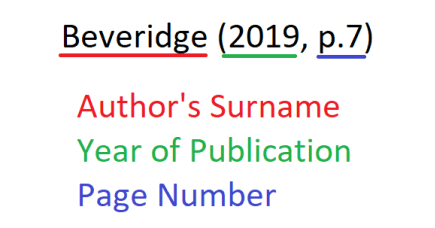
Citation

Author’s name in text

  1. Dowling and Pfeffer (1975) observe CSR and charitable donations are a, context specific, form of legitimising behaviour.
  2. Suchman (1995) views legitimacy as a process and Deephouse (1996) sees it as a state. Framing legitimacy as a state lends itself to measurement but diminished nuance, whereas, Suchman accommodates for change, conceptualising the implications of production, consumption, and activity.

Example 1 is standard example citing an author’s name in text. Example 2 uses two author’s name in text citations in one sentence. It’s useful in this context as it allows the author to distinguish between two thinkers on legitimacy. This demonstrates reading but also the implications of endorsing one perspective over the other.

Author’s name not in text

  • Organisations operate as part of a ‘superordinate social system’ in which the utilisation of resources, in light of the relative opportunity cost, affords some degree of legitimacy while goals resonate with society at large (Parsons, 1956).

This example paraphrases Parsons and opts to include his name in text. This decision is due to paraphrasing and a personal preference to preserve narrative flow.

Quotation with author’s name in text

  • Suchman (1995, p. 574) defines legitimacy as: the “generalized perception or assumption that the actions of an entity are desirable, proper, or appropriate within some socially constructed system of norms, values, beliefs and definitions”.

This is a definition. Definitions must be quoted, and all quotes require page numbers.

Quotation with author’s name not in text

  • ‘Older sociology… tended to rest on the idea that deviance leads to social control. I have come to believe the reverse idea, i.e., social control leads to deviance’ (Lemert, 1967, p. v).

An assertion on the nature of discussed phenomena. Similar in purpose to using a definition. Author’s name is not included to preserve the narrative flow, it is a hanging quote at the beginning of a section to frame the premise of the argument.

Two authors in text

  • DiMaggio and Powell (1983) observed that institutionalised organisations were becoming increasingly homogeneous; pushed into alignment with prevailing institutional ideals by a process called isomorphism.

This is how you include a citation with two authors. It’s the same as a citation with one author. The only difference is two people wrote it.

Two authors not in text

This demonstrates two sources of two authors not in text. This example is useful because it reports agreement on a specific aspect of legitimacy from two sources. If more sources agree on this specific issue (and they probably do) it’s acceptable to include them also.

Three, or more, authors in text

  • It is worth observing Mitzberg et al’s (2009) miscomprehension on the existence of choice, neo-institutionalists do not claim choice does not exist but instead insist choice is restricted based upon external factors. The greater the restriction the more complicated institutionalists perceive the environment to be.

Here’s an example some find confusing. So, three authors is written most frequently as the name of the first author and the rest abbreviated to et al. Mintzberg et al means Mintzberg and others, with et al being Latin. Hence the use of italics. Sometimes you will see the full citation written out including all names. Those who do this will only do so for the first time the citation is included. Each time thereafter will use et al.

Three, or more, authors not in text

  • Acquiring legitimacy “is a contested process that unfolds through time” (Johnson et al., 2006, p.59) via implicit and explicit processes.

This functions the same way as citing three or more authors. The example shows you a definition, hence the need to quote, and the appropriate page number.

Combinations

  • In modern management writing, one of the earliest definitions of an institution comes from Hughes (1936, p.180): “The only idea common to all usages of the term ‘institution’ is… some sort of establishment of relative permanence of a distinctly social sort”. Understandings of institutions are not confined to management literature but are also explored in economics, political science and sociology. There is consensus amongst social scientists that institutions exist but there is more agreement on what institutions are not rather than what they are (DiMaggio & Powell, 1991). Due to embedded ontological assumptions, which will become apparent in the upcoming section, this thesis adopts the neo-institutional perspective (DiMaggio and Powell, 1983; Meyer and Rowan, 1977) but those wishing to learn more on differences – although attention is given when necessary – between the perspectives should consult Scott (1987).

This example shows several of the citations discussed combined as part of a coherent paragraph. The more practiced you become in citing correctly the more natural this process becomes. Any journal article or academic text you consult will provide you with examples of this.

There are many more ways of citing dependant on the source material, e.g. websites, industry reports, government white papers, to name a few. If I were to cover all examples you would fall asleep. I’m not trying to bore you; I’m trying to give you necessary knowledge. So, with this in mind, I direct you to the aforementioned Anglia Ruskin University Library website on Harvard referencing. It is indispensable.

How to Reference

The reference list includes the full details of every source cited in the assignment. Citations are short-hand acknowledgments whereas the reference list includes the source materials full details. This allows the marker to inspect the validity, reliability, and quality of your sources. If the information included is insufficient to do so then no credit can be given for that part of the argument.

As I have done for the How to Cite section, I will provide examples of full references for the following sources: journal articles, textbook, edited books, chapters of edited books, websites, and online newspaper articles. I’ve selected these as, in my experience, they are the most common types of reference.

Journal article

The formula – Author(s). (Year of publication), title of article, title of the journal containing the article, journal volume number (journal issue number), the page numbers of the article within the journal.

Here are two examples. One with more than three authors and one solo author:

Alexander, M.J., Beveridge, E., MacLaren, A.C., & O’Gorman, K.D. (2014). “Responsible drinkers create all the atmosphere of a mortuary”: Policy implementation of responsible drinking in Scotland”, International Journal of Contemporary Hospitality Management, 26 (1), pp.18-34.

Suchman, M.C. (1995). Managing legitimacy: Strategic and institutional approaches. Academy of Management Review, 20(3), 571-610.

Textbook

The formula – Author(s). (Year of publication). Title of book, location of publisher: name of publisher.

Hall, S., Critcher, C., Jefferson, T., Clark, J., & Roberts, B. (1978). Policing the Crisis. Mugging, the State, and Law and Order. London: MacMillan Press.

Parsons, T. (1956). Structure and Process in Modern Societies. New York: Free Press.

The titles of books are italicised because it’s the name of a publication.

Edited Book

The formula – Author(s), ed or eds. (Year of publication). Title of publication, location of publisher, name of publisher.

Powell, W.W., & DiMaggio, P.J. eds. (1991). The New Institutionalism in Organizational Analysis. Chicago: University of Chicago Press.

Chapter of an Edited Book

The formula – Author(s). (Year of publication). Title of chapter. In (name of the editors) (eds), title of book, location of publisher, name of publisher.

Beveridge, E. & O’Gorman, K.D. (2012). The Crusades, the Knights Templar and Hospitaller: a combination of religion, war, pilgrimage and tourism enablers. In R. Butler & W. Suntikul (eds), Tourism and War: A Complex Relationship. Contemporary Geographies of Leisure, Tourism and Mobility, London.

DiMaggio, P.J., & Powell, W.W. (1991). Introduction. In W.W. Powell and P.J. DiMaggio (eds.), The New Institutionalism in Organizational Analysis. Chicago, IL: University of Chicago Press.

Website

The formula – Author(s) or Source name. (Year of publication). Title of web page, (date updated, if any), Available at: Insert web address.

NHS Inform. (2019). MMR Vaccine, [online], (Updated on 23/08/19), Available at: https://www.nhsinform.scot/healthy-living/immunisation/vaccines/mmr-vaccine

Scotch Whisky Association. (2019). Scottish Parliament raises a glass to 525 years of Scotch Whisky, [online], Available at: https://www.scotch-whisky.org.uk/newsroom/scottish-parliament-raises-a-glass-to-525-years-of-scotch-whisky/

Online Newspaper Article

The formula – Author or Name of newspaper/publisher. (Year of publication). Title of article or page, name of newspaper/publisher, date of publication. Available at: URL

Duell, M. & English. R. (2019). Meghan Markle flies COMMERCIAL! Duchess leaves four-month-old Archie at home for two-day trip to New York on public flight to watch her friend Serena Williams play in US Open in wake of private jet storm, Mail Online, [article] 06/09/19. Available at: https://www.dailymail.co.uk/news/article-7434713/Meghan-jets-New-York-watch-friend-Serena-Williams-play.html

Kijewski, L. (2019). US woman charged with trying to smuggle baby out of Philippines, The Guardian Online, [article] 06/09/19. Available at: https://www.theguardian.com/world/2019/sep/05/american-philippines-baby-human-trafficking-charge

A few final words

This may seem a little overwhelming, but if you just get your hands dirty and begin to learn the ins and outs through practice, you’ll do fine. Here are a few final bits of advice.

Consistency

Be consistent. When comparing sources, you’ll find small differences. Some references use a full stop where others use a comma. Some include the authors first name instead of an initial. Others may include the ‘Vol.’ abbreviation before including the journal volume number. What’s important for you is to pick one of these and stick to it. Chances are your marker will only take issue with it of you have discrepancies within your work, i.e. two different formats for writing a journal reference. Keep it all the same. Be consistent.

Reference list not bibliography

This makes my head want to explode. Reference lists and bibliographies are not the same. Every single year students act like they are, despite persistent cajoling to the contrary. A reference list is every source cited in the written work. A bibliography is every piece of reading which may have influenced your writing. Bibliographies have no place in task-oriented university assignments. Reference list not bibliography.

Include Everything

If you cite a source, you must include it. If you don’t include a corresponding reference for your citation no marks will be awarded for those sections. Include everything.

Presentation

This is linked to be consistent. Presentation is a massive deal. When the marker flicks straight to the reference list and finds a disordered mess waiting on them. They will immediately start taking notes of all the mistakes. If you take care of presentation and be consistent, it’ll go a long way to help maintain good standards in your refencing.

Software and websites

This has the potential to be beneficial and enormously detrimental. Endnote is an excellent piece of software (Available to Strathclyde University Students via the library.) and a great boon for citing and referencing assignments. However, the software is only as good as the user. If the software is not properly set up and, most importantly, you don’t know what the outputs are supposed to look like then its useless to you. The bottom line is you need to know how to reference first before you start using this software. Websites *audible sigh*… over the last few years there’s been a rash of students using Citethisforme and perhaps other similar websites. I don’t mean only first years, third and fourth years too. Students who should know better. The references it gives you are wrong. Not a little wrong but horribly wrong and the presentation of them is garbage. Do not use these sites to do your work for you. You will receive zero credit for this significant portion of your assignment if you do this. Markers will know you’ve done this immediately and you will come off as someone who doesn’t care about their work. Avoid rubbish websites. Endnote is excellent but its only as good as the information it receives and operated by someone who knows what referencing and citing is supposed to look like.

Fin.

That’s us finished. For those new to this, I hope you’ve learned a few things about what to do and what to avoid. For those refreshing, I hope you’ve found what you needed. If not, please leave a comment with any specific questions. Remember, when in doubt, consult and bookmark the Anglia Ruskin University Library page on Harvard referencing. It’ll keep you on the straight and narrow. Best of luck in your assignments.

Featured post

The Devil’s Pulpit

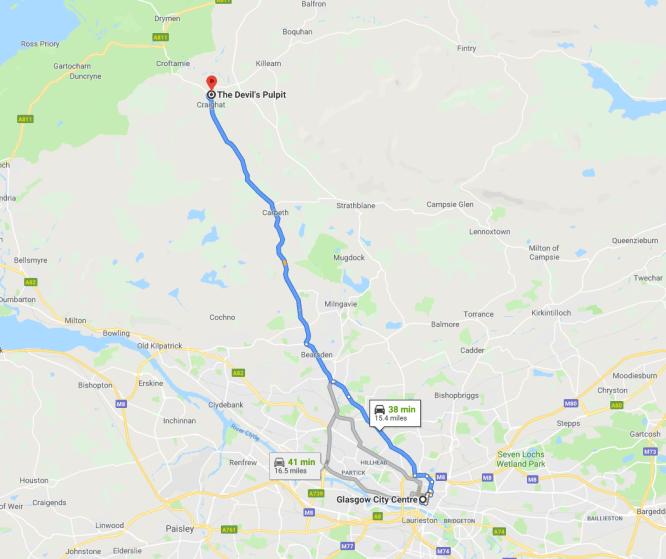
So, there’s a cool little spot on the road to Loch Lomond when heading north out of Glasgow. It’s maybe 30 minutes by car.

The Route

Devil's map

It’s called the Devil’s Pulpit because there’s a natural rock formation resembling a preacher’s pulpit. The soil of the riverbed is red (Maybe sandstone?) and the water takes on a crimson hue. Put the two together and the mythology of the Devil preaching to his followers while wading through a river of blood takes over. The site itself is located in Finnich Glen.

Bring:

  • Decent footwear. Boots or hillwalking shoes if you’ve got them.
  • Towel
  • Wear clothes you don’t mind getting wet or dirty. You WILL get wet and the red soil gets everywhere.
  • (Optional) Full change of clothes.

The visit is great for a morning or afternoon trip. I’d recommend the morning as the place gets quite busy, especially if you’re going at the weekend, and parking could be an issue. It wasn’t for us but we arrived at 10am.

The DP is in a gorge off the main road but you need perseverance to get there. You enter the trees via a gap in the wall and follow a rough path down to the gorge entrance. There will be other people there. Chances are you’ll follow others or the sound of voices to get where you need to be. Once you see the steps you’ve arrived. They’re steep and dangerous so you want to take care but it’s manageable. Going down is much harder than getting back up.

Stairs down.jpeg

Once you’re down it’s all good.

Bottom of the stairs.jpeg

You can either turn left or right when you get down there. The DP is left and other cool river scenery is right. We did both but headed to the pulpit first. Now, most people keep their shoes on… we didn’t. We went full Hobbit wading through the water barefoot. Ten times more fun. You’re going to get wet anyway and if you have a towel it doesn’t matter. Plus, you’ll never tire of scolding your mates with “Fool of a Took!” if they stumble, “Thief Baggins!” when they pinch your sunglasses, and “You’ll have to toss me!” when sizing up jumps from stone to stone. We might have gotten a bit carried away with the Lord of the Rings jokes…

This slideshow requires JavaScript.

The pulpit is just up ahead, you can see the approach peering over my shoulder in the second photo. I’m not going to lie to you, the water is cold, but you adjust very quickly and its way more fun and involving to get in the water. We saw lots of people trying to climb their way around the river, hugging the walls, trying not to get their kit wet. This is definitely not the way to do it. You can see the red waters from the pictures, it’s not hard to imagine just how many stories have been told over the centuries about why the water’s red. The deepest areas of water are almost black.

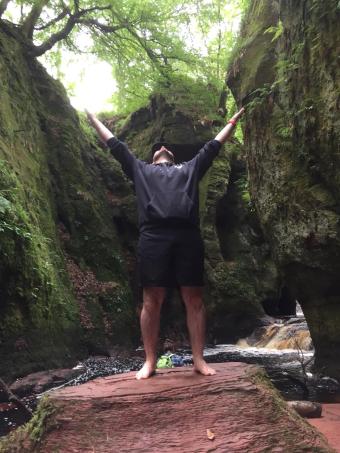
We did a bit of posing with the pulpit… see exhibit A, B and C.

keith on pulpithandsome devils


euan pulpit

And then we saw this…

The falls.jpeg

Long-story-short, we had to swim in it. Didn’t come all that way to just look at it, did you? If you did, you need to have a word with yourself.

getting wet

The swim was fun and you adjust to the cold quickly. After you come out and dry off you are energised. On a side note, it’s actually convinced me to try cold showering because, as I said, I felt great and if I can have that feeling every day then I’m game. Here’s a post drying off pic.

Post dip.jpeg

We headed back to our bags at the foot of the stairs and decided to explore further down river. There is a rock formation down this way I wish I’d gotten a picture of. Alas, I did not but it’s worth heading to. There’s an overhanging cave above a similar pulpit arrangement. We wandered further downriver but the scenery became less remarkable so we decided to backtrack. The walk was about 4km once done. A decent hustle when barefoot walking through water. We got back. Dried off and started climbing back out. The place was getting busier and we were all thankful for the earlier arrival. Most people there were tourists so it was nice to see people from all over coming to enjoy this special little place. We headed back to Glasgow for a burger and a beer before lounging in Kelvingrove park. Pretty sweet day out and I’d recommend it to anyone if the weather’s good.

Thanks for reading.

Euan

Why Storytelling is Great for Learning

Why I Think Storytelling is Great for Learning

I think storytelling is great for learning for two reasons. I think human beings are hard-wired to learn this way; and stories can impart specific lessons with room for post-telling reflection.

Hard Wired

I find it hard to disagree with my assertion that human beings are hard-wired to learn via oral exchange, i.e. speech and storytelling. Human beings (homo sapiens) have been around for roughly 350,000 years. However, it didn’t take long to develop sophisticated language, with the origin of speech estimated during, the very large window, of 350,000 to 150,000 years ago. Let’s be as stingy as possible and assume our species has been speaking for 150,000 years.

We don’t think of writing as technology. Our minds consider steam power, electricity, automation, A.I., digitisation as the fruits of technological revolutions. Writing is a singularly important technological revolution for our species. The earliest examples of writing are called ‘proto-writing’, using symbols and images, to convey a restricted number of ideas unlike writing which specifically communicated the language of the author. Cuneiform of Ancient Sumeria is one of the oldest (3,400 BC), then hieroglyphics of Ancient Egypt (3,100 BC), and the Xia Dynasty China (2,000 BC). There are some older examples, like the Indus and Rogongo scripts dated around 5,500 BC, but whether they can be classified as proto-writing is debated by academics. Actual writing, the accurate communication of spoken language in written form was in the Near East around 2,600 BC. This technology emerged as civilisations expanded enough to require treaties, trade agreements, peace agreements, recorded history, commercial arrangements, etc. It played a significant role in civilising the world. Civilisations existed across the globe at this point. The dissemination and implementation of writing didn’t occur simultaneously across all cultures. Many places didn’t adopt writing for many centuries. Take Scotland, my home, as an example. Scotland adopted writing, in Latin, between 600-700 AD after the decline of the Roman Empire due to the zeal of Christian Missionaries. Knowledge of older civilisations in Scotland is scarce due to a lack of written records.

Bearing this in mind, I will for the purpose of my own argument take the smallest window possible to illustrate my point. So, we’ve been able to speak for 150,000 years. It’s been 4,600 years since the implementation of recognisable language in the Near East. That means human beings had 145,000 years of communicating, speaking, teaching, preserving history and tradition, without writing. It’s a long time and it’s why I think we can underestimate the value of learning done via oral communication.

Lessons

I think storytelling is undervalued in the classroom, and when I say ‘classroom’ I’m including lecture theatre and tutorial seminar. Civilisations’ preserved oral histories and traditions for 150,000 years as a means of providing lessons for future generations, preserving culture and identity but also to prevent future generations from repeating mistakes. The best legacy of this are the rich myths, fables and parables that have emerged across the globe. Some educators already use the storytelling approach but call it something else, e.g. using case studies. Case studies tell a story, offering contextual richness for students and academics to explore, hang theory on, and facilitate analysis. Historical case studies are an exceptional teaching tool because it forces students to think beyond the immediate information and do further reading on macro-environmental forces impacting decision making. A good example is the Harvard Case using Singer (Sewing Machine manufacturer), one of the first multinational corporations growing across America, UK, Germany and Russia against the backdrop of two world wars. Complex situations affecting actors’ decision making is key to deriving understanding and meaning. This case study is a compilation of stories, key individuals who furthered the success of the organisation. Protagonists within the Singer Saga. Using stories, classic, modern literature and even film, offers many opportunities for exploring academic literature, in my case, business and sociological literature.

The value of stories, myths, fables and parables are the lessons they impart. There is always an intended lesson to be learned but there may also be additional layers which are not initially apparent. Something later realised after pondering. The lesson is often a moral one, one that defies the primal urges of our mammalian natures. Some examples include:

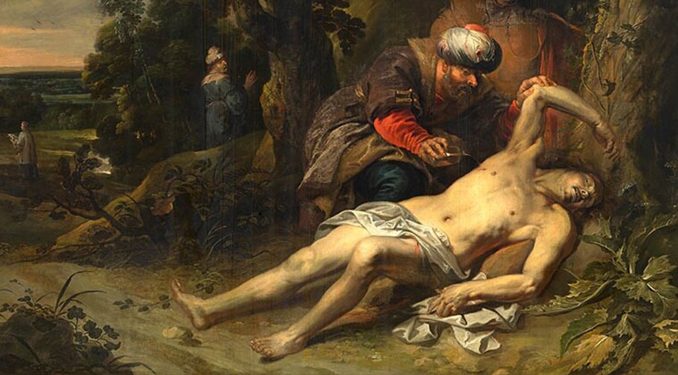
goodsamaritan.jpg

(Balthasar van Cortbemde’s Parable of the Good Samaritan)

The Good Samaritan. This parable, told by Jesus if Luke’s gospel is to be believed, can be interpreted in different ways. I’ll use the ethical one as the allegorical reading is more appropriate for those debating religious semantics. Jesus’s audience during the telling were Jews. At this point in time Jews hated Samaritans and vice versa due to an older conflict between the warring tribes. The Jewish traveller in the story is beset, robbed, beaten and dumped by the side of the road by brigands. He pleads for help from Jewish passers-by, but they won’t hear his pleas. When all hope is lost it is a Samaritan who stops and shows compassion. The last person any of his audience would have thought would aid the Jewish traveller, the person in the story whom his audience would identify with most. The deeper lesson would be to then reverse the roles, so literally, if a Jewish traveller discovers a Samaritan in need of help then he should do so, more abstractly, the lesson is to provide help to those who need it no matter how different they are from you.

rembrandt prodigal

(Rembrandt’s Return of the Prodigal Son)

The Prodigal Son. Another parable from Luke’s gospel, tells the story of two sons. One patient and dedicated with a sense of duty; and another who wishes to pursue pleasure and excess with no real thought beyond that. The prodigal son demands his inheritance early and blows it all, ending up an indentured servant when the money runs out. He returns to his father, contrite for his foolish actions and wishes forgiveness but expects none. His father grants him forgiveness and welcomes him into the family home once again. This comes as a surprise to both sons. The prodigal because he is genuinely ashamed of his wastefulness but also the eldest son who stayed. He feels spurned because his youngest brother, to his mind, deserves rejection as punishment. The parable is one about redemption and reformation. That we should grant forgiveness and opportunity for those who admit to wrongdoing when making amends. Not only should we do this but we must also try and do so without resentment. Interestingly, there is a similar Buddhist parable predating Luke’s gospel, indicating a much older history to the parable.

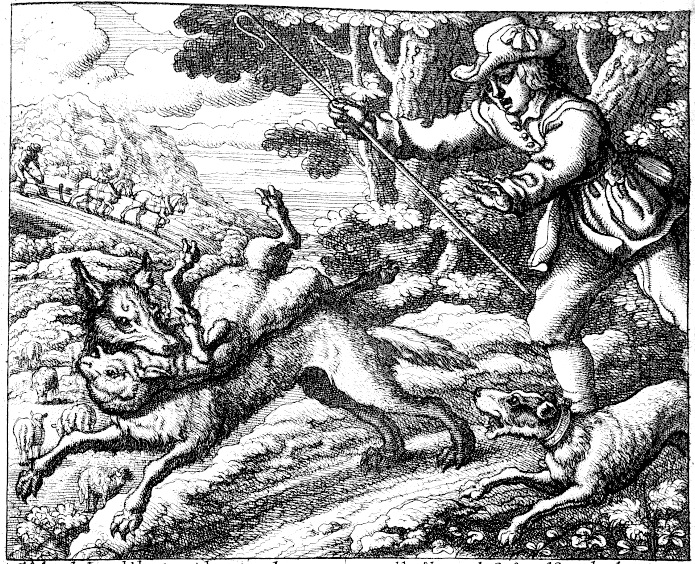
Boycriedwolf

(Francis Barlow’s The Boy Who Cried Wolf)

The Boy Who Cried Wolf. Often thought of as a Biblical tale. It was certainly taught to me in religious education classes as a child but it comes from the Greek storyteller Aesop around 600 B.C. As we mentioned earlier, the story is likely much older. This fable, and fables are distinct from parables, has a shepherd boy lampoon local villagers about a wolf attacking their flock of sheep. There is no wolf and different stories provide a different motivation for the boy carrying out his trick. It’s most often for his own amusement. He does it a number of times, not tiring of the panic when everyone thinks the big nasty wolf has arrived. The point is he does it so often that when a wolf does come no one believes. He sounds the alarm and no-one comes. Some sheep, maybe even the whole flock, are killed. In some versions even the shepherd boy is killed. The moral being don’t tell lies. With the further caution that the more lies you tell the less people will believe you. The young boy in the story is convenient for parents’ to chide children about telling tall tales. We even have the English phrase warning against “Crying wolf”.

Tortoise_and_hare_rackham

(Arthur Rackham’s The Tortoise and the Hare)

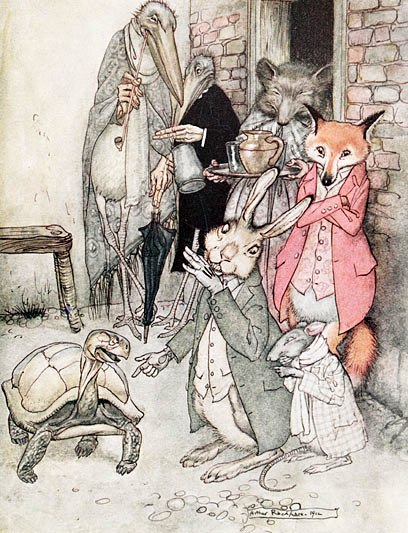
The Tortoise and the Hare. Another of Aesop’s fables. This is quite interesting, especially given my point about the usefulness of stories stemming from later reflection. The English phrase of “Slow and steady wins the race” is often attributed to this fable. The fable involves a hare ridiculing a tortoise for how slow he is. The tortoise endures it for a while but hates the embarrassment in front of the other animals. He decides he’s had enough and challenges the hare to a race. To all onlookers it appears absurd as a hare is much faster than a tortoise. They race and the hare speeds off. He gets so far ahead that he decides he can have a nap. He oversleeps and the tortoise overtakes him and wins the race. So “Slow and steady wins the race”. You could even think it’s about the importance of standing up to bullies. I don’t think it is. This story, true to Aesop’s Greek heritage, is about hubris. This is a warning against pride. The hare, who should’ve won this race hands down, is beaten by someone who had no business being in a race with him in the first place and it is entirely his own fault he lost.

Not just for kids

Now, the common theme here is that all of these four stories are used to teach children. I would forgive you for point out to me that I teach adults. In fact, you could take it further and say, you teach business subjects to adults at university. Why are childrens’ stories at all relevant to this? You are missing my point if this is your question. Storytelling is the methodology, the content of the story is for the teacher/tutor/lecturer to decide. Colourful characters, adventure, romance, monsters, magic, heroism, exotic locations, gods and goddesses may attract children but it attracts adults too. It is the storytellers job to reinforce the intended lesson underneath those colourful trappings. It may even require outright exposition but, as per my initial hypothesis, I think we are hard-wired to learn this way and it reinforces learning. As per my second hypothesis, it will provide intended instruction but it will also prompt later reflection. Greek tragedies are wonderful in this regard, as the tragic act itself is often a result of some basic human failing and demand answers. Answers we can never fully provide.

Why did Icarus not listen to Daedalus?” “Why did Orpheus not ignore Eurydice for another five minutes? They were almost free.” “Why did Midas hug his daughter?” “How could Theseus forget to change his sails from black to white?

Always with the Questions

This is the important bit. Questioning. In my experience, I’ve conducted a successful lecture when a student comes to ask a question afterwards. The question tends to come, whether consciously or not, from a philosophically critical perspective. Why? In a lecture there is little opportunity to ask questions. A tutorial allows open questioning. So, during the lecture the student hears the information and it pricks them. There’s something about it that doesn’t sit right and they wrestle with it internally throughout the class. The lecture finishes and they come to you with their question. Best example I have of this was during a lecture I provided on the philosophy of hospitality. Without going into too much detail, I asserted that altruism doesn’t exist. There’s no such thing as a selfless act. Every action a human can perform is transactional because even the satisfaction one takes from a charitable act is not selfless. The person receives satisfaction in exchange for their money or time, whichever it may be. The conversation went on for a while. The student even followed me back to my office with more questions about it, they suggested books I might like and he wanted reading h to learn more. These moments make education meaningful. This young man held something to be true and this conviction was fundamentally challenged. Irrespective of whether altruism is real or not, that process of critically examining our core ontological beliefs is fundamental to intellectual development. We never stop learning and I plan on folding storytelling into my teaching repertoire.

The Subtle Art of Not Giving a Fuck: Values

After listening to The Subtle Art of Not Giving a Fuck: A Counterintuitive Guide to Living a Good Life it made me contemplate my own values. This involves reflecting on what I currently value, what I once valued and what my values should, maybe even need, to be. The idea is to better help me achieve my goals and a sense of fulfilment.

I’ve added an image. It’s a great book, a short read (or listen), accessible, and concisely written. Check it out. I’ll be reading Manson’s Everything is Fucked: A Book About Hope once I’ve finished Stephen Fry’s Mythos. I’ve only just started it but it’s a nice compliment to the series of blogs I’m writing on storytelling.


(Images extracted from Amazon.co.uk)

Values naturally change over time for a variety of reasons. There have been times when, both consciously and unconsciously, my values have been beneficial and detrimental. After listening to Manson’s audiobook I’ve been thinking about times I made decisions altering the course of my life. Opportunities taken and missed; relationships ended, pursued or never begun; careers disregarded; people I under or over-valued and others neglected entirely. All of this informs the values I choose for myself.

I like this way of thinking. I like it because it makes you, the individual, responsible for your own actions. There are no scapegoats. No excuses. It’s your fault but it can be resolved by addressing what you choose to value. This is a core part of the book. It addresses the fact that what happens in your life is directly affected by what you choose to Give a Fuck about. By the same token, you are also choosing what not to Give a Fuck about. So, I’ve considered new values, better things to Give a Fuck about in order to help me improve aspects of my life:

  • Being honest with myself and my loved ones – Anyone who knows me will probably scoff at this, it’s likely both a boon and a curse of my friendship, you’re getting my unvarnished opinion whether you like it or not. It’s not always ideal but I have no filter. Probably explains my small circle of friends. I need to focus that cutting scrutiny on myself. Cutaway the bullshit and focus on what matters.
  • Being confident in my own abilities – Doing things. Sounds obvious, right? That’s because it is and looking at it now it angers me to write it but in the interest of honesty I need to include it. I’ve really come to undervalue myself and my own abilities. I would’ve found the idea of me lacking confidence absurd a few years ago but there it is and I need to remedy it. The best way to do that is to take risks, be bold, and move forward. Prove to myself I’m good at what I do. As Jordan Peterson, would say “Stand up straight with your shoulders back” and plough on.
  • Always improve my professional competence – Doubling down on my skills. Competence breeds confidence. Part of writing this blog is to do with competence. It’s informal writing practice. I don’t need to continually double check I’m not wrong, it’s just my opinion and it gets ideas on paper. But, with respect to improving my professional skills… see that call for conference papers, Euan? Get one in. That professional workshop on research methods? Get your ass along to it.
  • Fully commit to my endeavours – Once beginning a task I need to see it through promptly. No procrastinating or putting frivolous things before work. My seven-year PhD is a testimony to this… certain unfortunate factors aside (which I might go into another time), this process has gone on two and half years too long for absolutely no reason. Four years would have been acceptable. The only person losing out is me. It could be anything from the frivolous to the imperative, e.g. getting a faster 5km time, getting a heavier deadlift, eat more veggies, save a mortgage deposit, not abandoning relationships pre-maturely. I need to fully commit to my endeavours. Honesty substantially impacts this, I need to be honest with myself about what’s important and what I wish to achieve, not just in any given day but in the future too. Confidence will improve this way too. Achieving goals is a win. It bolsters you. It helps you realise what you can achieve and perhaps limitations placed on yourself are holding you back.
  • Temperance – This is informed by honesty and commitment. I mean temperance in the Aristotlean sense, conscious and deliberate exercising of self-control. It’s cutting down on all the extra-curriculars which have started taking up entirely too much of my time. If we envision a pie-chart depicting how my time is allocated amongst activities, all of those considered fun take up too much of my time. That needs reigned right in.
  • To become fully independent – I need to stand on my own two feet again. I regressed about four years ago, things got tough and instead of standing up and taking it on the chin I ran away, hid and developed a lot of bad habits. I lost a grip on my own sense of purpose and I’ve become dependant on other people. Time to fix that.

There it is. That’s what I’ve chosen to Give a Fuck about. I’ve burned these six things into my brain and I know when I’m living by these values and when I’m not. When I forget I’ll come back on to publish a blog entry and there they’ll be. Reminding me of what I promised myself I’d do to be better at what’s important to me. Honesty; Confidence; Competence; Commitment; Temperance; Independence.

Why I love storytelling

I love stories. The earliest story I remember is a bedtime favourite my dad told me, The Three Billy Goats Gruff. I loved it and my dad loved telling it.

“What story do you want tonight, wee man?” he’d ask.

“Three billy goats gruff please dad. Please please please”. I had the book but he didn’t need it. He was a dab hand. He’d do voices and act out scenes. I loved it. I’d squirm and hide under the sheets when the scary troll appeared to bully the little goats and I’d giggle and laugh when the final billy goat rammed that nasty troll off the bridge. It’s one of my fondest childhood memories.

I was a good reader as a child. I was reading my own bedtime stories at quite a young age but it was always better when someone else read them to you. Asterix and Obelix were the mainstays if you don’t know them you need to look into it and, I promise you, if you have kids do them the favour of getting them a few to try them out. You won’t regret it. Reading books on my own let me delve into all sort of fantastical rabbit holes.

I was spoiled as a child. Very spoiled. Probably the best way was in books. My parents, especially my dad, was – still is for that matter – a voracious reader. I was too young for those books though but thankfully I had two older brothers and a godmother (who went on to be an expert in child education) who drowned me in books. J.R.R. Tolkien, C.S. Lewis, Asterix and Obelix, Calvin and Hobbes, classic myths of Ancient Greece, the Vikings, and King Arthur were my staples. It wasn’t long before I would consume my eldest brothers dungeon masters guide and monster manual from cover to cover. I could quote you entire sections, despite never having played a single session of D&D, because the details were so rich and consistent. I was cultivating my inner geek back in ‘88.

I was never a good school pupil. Shocked? You clearly don’t know me. I was too wilful and believed myself much smarter than I really was. A tiny extrovert, bursting with energy, and no attention span. I found it hard to maintain focus in many lessons – unless it was reading or writing stories about dragons- until I was in primary 2. That’s the second year of elementary for any non-Scots reading this, about age 6. That’s when I met Mrs. Barlow. Now, let’s get this straight. Everyone was terrified of Mrs. Barlow, she was old, needed a cane, grumpy, had blue-purplish rinsed hair and a manner of reprimand that chilled to the core if you stepped out of line.

“You boy!” She’d boom. The whole room would stop. Thirty kids simultaneously praying the old dinosaur’s vision was based on movement. No such luck.

The memories, even now, make me frosty. However, I remember stepping into her classroom, I don’t know why we were there but it was the whole class. The walls were covered in images of all the tales I knew of Ancient Greece, I saw Heracles and his labours, the birth of Athena, Odysseus and the Sirens, Theseus slaying the Minotaur, Perseus holding Medusa’s head, King Midas, imagery of the Underworld and a list of the Olympian Pantheon. This terrifying old lady made me feel more at home than I’d ever been at school just by being in her room.

“Why does she have all this cool stuff,” I thought. “This can’t be school stuff”. There were a couple of other kids who had an idea of what all the decorations were but I felt like I held the Rosetta stone. I had the inside track others didn’t.

Mrs. Barlow would often tell us stories and I’ll tell you this… my attention was focussed. I absorbed every single minute detail and she transformed from tyrant to kindly grandmother telling stories by the fire. I bombarded her with questions, no longer fearing her attention, she had the answers I needed. She did a pretty good job of always telling us something new despite the finite supply of Greek myth after all. Now, we were small kids, the more salacious details of some Greek tragedies were obscured from us (No stories of Oedipus… well… we all know how that goes, or Zeus sleeping with women in the guise of a white bull or some such.) but they did a good job by us and I found out the extra details when I got older. My love of these myths never left me. In all honesty, their value only increased when able to conduct more adult analysis of them. I think this is the core reason why I love them so much, they have meaning and relevance for everyone. The moral tales at their heart are often multi-layered and survived the rise and fall of civilisations. I sincerely believe we must never lose this method of moral teaching. That’s what such stories are, reflections on morality, ethics and human nature. These are considerations no human being should ever be without.

Every kid needs parents and siblings like mine to feed them these stories. Failing that, they need their own Mrs. Barlow, a terrifying, purple-haired, Scottish schoolmistress, with a voice to make a drill sergeant flinch, weaving stories of goddesses and princes, princesses and heroes, heroines and monsters, curses, swords and magic to spellbind hyperactive children, help them to think, always dream and, most importantly, always question.

Restarting what never began

I got an email indicating my WordPress subscription had automatically renewed. Didn’t know I had one… I knew I’d flirted with the idea but cannot remember writing that first post.

Well, here we are again. Let’s try and have a proper go this time. Unabashed and unedited? Think I’ll try and stick with that. It’s 1.30pm on a Saturday afternoon in Larbert. I’m due in Vodka Wodka at 5pm for a dreary shift that’ll no doubt drag heels over every inch of that grimy floor. What we do to almost cover bills, eh?

I’m hoping that these upcoming months will catalyse change. I want a new job, so I’m furiously foraging through every recruitment site, looking for anything I can pay rent with. I want an academic post, teaching or research, but it needs to be new. I can’t go back to the same old stuff for peanuts money. It’s not worth it. We all deserve better out of life.

There’ll be more later. I’ve got gym stuff to post (I promise anyone reading this that I won’t be that guy, the interest will likely burn out too fast for me to get close to being THAT guy, but hey, self-improvement should always be encouraged.) Also, Boris Johnson became UK PM… I have no doubt there’ll be a few entries entirely dedicated to his antics or over-reactions to new policies.

Purpose

The purpose of this blog/page/site/whatever it ends up being is to keep me responsible and accountable for my life, thoughts, and career (early development as it may be). I’ll try to keep it pithy and unedited (Unless something really grates me; then colourful curated rants will cascade onto the page.) as an enticement to write regularly and often. My brain needs the stimulation away from simply writing for work.  Hopefully, I can produce something of merit every so often.

Let’s hope something good comes of this (And I suss out how the site works quickly)

Slainte

Euan


Website Powered by WordPress.com.

Up ↑